AI used to be the competitive advantage. Now it’s the norm. Every company you compete with has access to the same tools, so the edge in 2027 isn’t the technology. It’s people who ask better questions, try new things, and stay connected to each other while everything around them changes.
That’s why more event planners are booking a curiosity keynote speaker for kickoffs, leadership summits, and all-hands meetings. The timing makes sense. According to Gallup’s State of the Global Workplace: 2026 Report, global employee engagement fell to 20% in 2025, its lowest level since 2020, costing the world economy an estimated $10 trillion in lost productivity.
This guide covers what a curiosity keynote is, what a great one delivers, how to choose the right speaker, what it costs, and how to make the message last long after the applause.
| Quick answer A curiosity keynote speaker helps teams swap fear of change for better questions. The right one shares a personal story that makes curiosity feel safe, gives people a simple framework like “How might we?”, and connects curiosity to results leaders care about: adaptability, collaboration, engagement, and culture. |
What Is a Curiosity Keynote Speaker?
A curiosity keynote speaker is a professional speaker who helps organizations turn curiosity into a daily habit. That means asking questions, challenging assumptions, and exploring new ideas without the fear of looking wrong.
It’s different from an innovation talk that focuses on process, or a technology talk that focuses on tools. A curiosity keynote focuses on mindset and behavior: how people think when things change, and how they treat each other while it’s happening. The best ones tie curiosity directly to outcomes your leaders already care about, like adaptability, collaboration, retention, and a culture people actually want to be part of.
Why Curiosity Belongs on Your Main Stage in 2027
Engagement is sliding, and managers feel it most
Gallup’s 2026 report found that the share of engaged employees worldwide dropped for a second straight year. Managers took the biggest hit: their engagement fell five points in a single year, from 27% to 22%. When the people leading teams feel stuck, everyone feels it. Curiosity gives leaders a different way to lead: asking instead of only telling.
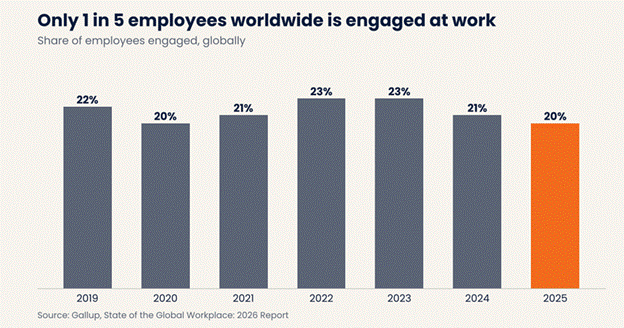
Global employee engagement, 2019–2025. Source: Gallup, State of the Global Workplace: 2026 Report.
Employers already rank curiosity as a core skill
In the World Economic Forum’s Future of Jobs Report 2025, curiosity and lifelong learning sits alongside creative thinking and resilience as a skill rising in importance through 2030. Across industries, about half of the employers surveyed name it as a core skill for their workforce today.
Curiosity drives better work
Harvard Business School professor Francesca Gino’s research, published in Harvard Business Review, links curiosity to fewer decision-making errors, more creative solutions, and stronger, more trusting teams. One INSEAD field study cited in coverage of her work found that a one-unit increase in curiosity was linked to 34% greater creativity.
There’s a gap between what leaders say and what teams feel
Here’s the part most organizations miss. In Gino’s survey of more than 3,000 employees, only about 24% said they feel curious in their jobs on a regular basis, and about 70% said they face barriers to asking more questions at work. A separate SurveyMonkey study reported by ATD found that 83% of executives say curiosity is encouraged in their organization, but only 52% of individual contributors agree.
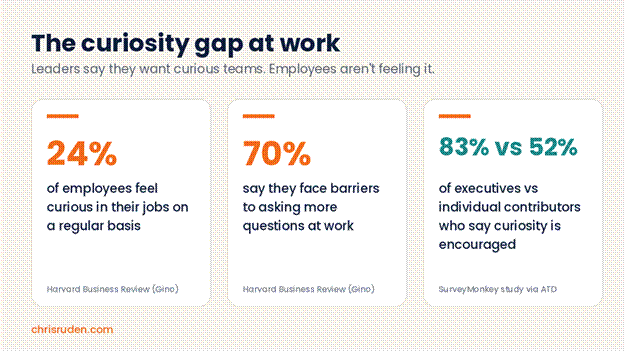
The curiosity gap at work. Sources: Harvard Business Review; SurveyMonkey via ATD.
That gap is your opportunity. A great curiosity keynote doesn’t just tell people to be curious. It gives them permission.
What a Great Curiosity Keynote Delivers
1. A story that makes curiosity feel personal
Statistics get nods. Stories change behavior. Look for a speaker who can turn their story into a vessel for a message, so your audience sees themselves in it and walks away thinking, “If they could do that, what’s stopping me?”
2. A reframe from legacy narratives to “How might we?”
Every organization has legacy narratives: the stories teams tell themselves that keep them stuck. “We’ve always done it this way.” “That won’t work here.” A strong curiosity keynote names those narratives and replaces them with a simple question your people can use the next morning: How might we?
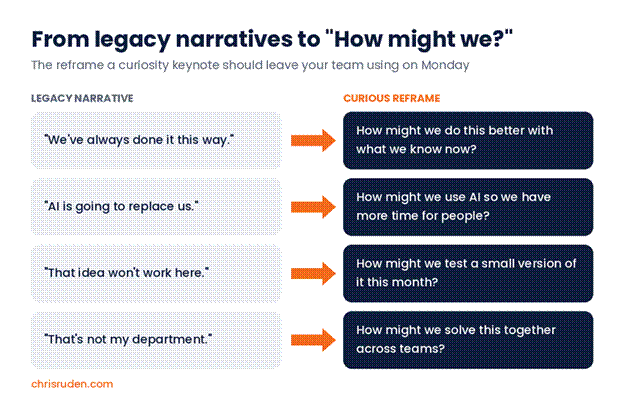
Reframing legacy narratives with “How might we?”
3. Real interaction, not a lecture
Curiosity is a practice, so the session should practice it. High engagement doesn’t have to mean “rah-rah” energy. It means moments where the audience asks, answers, moves, and connects with the people sitting next to them.
4. Tools people can use the next morning
Ask what attendees will do differently on Monday. Good answers sound like specific questions to use in meetings, a short team challenge, or a framework managers can bring into one-on-ones.
5. A bridge between curiosity and connection
The most useful curiosity isn’t just about ideas. It’s about people. When teams get curious about each other’s experiences, they build trust faster, collaborate better, and create the kind of psychological safety where good ideas actually get shared.
Curiosity Keynote Themes That Resonate in 2027
- Curiosity in the AI era. Helping people see AI as a tool that frees up time for the human work, instead of a threat to fear.
- Curious leadership. Moving managers from having all the answers to asking better questions.
- Curiosity and change. No one likes when change happens to them, but everyone likes when change happens from them. Curiosity is how you get there. (See our change management speaker checklist.)
- Curiosity and inclusion. Getting curious about how colleagues and customers actually experience your workplace and products. (Related: disability inclusion keynote guide.)
- Curiosity and engagement. Rebuilding energy in teams that feel burned out by constant change. (Related: how to hire an employee engagement speaker.)
- Curiosity for sales and customer teams. Asking better questions to understand what customers actually need.
How to Choose the Right Curiosity Keynote Speaker
Use this checklist when you compare speakers:
- They live the message. Look for a speaker whose own life shows curiosity in action, not someone reciting research.
- You’ve watched a full talk. A two-minute reel shows polish. A full session shows substance and pacing.
- They customize. Ask how they’ll tailor the talk to your industry, your challenges, and your event theme.
- The session is interactive. Curiosity is learned by doing, so the audience should be part of it.
- They’ve worked across industries. Range shows the message works beyond one type of room.
- They support follow-through. Workshops, resources, or follow-up sessions keep the message alive.
- They’re easy to work with. Flexible, responsive, and focused on your outcome, not their ego.
Questions to ask on your discovery call:
- What do you want our audience to do differently 30 days after the event?
- How will you learn about our team and our challenges before you build the talk?
- What does audience interaction look like in your session?
- Can you deliver in person, virtually, or in a hybrid format?
- What follow-up support do you offer after the keynote?
For a broader look at vetting speakers, see our leadership keynote speaker guide for 2026.
What Does a Curiosity Keynote Speaker Cost?
Fees vary widely based on experience, demand, format, and travel. These are rough ranges you’ll see across the industry:
| Speaker tier | Typical fee range | What you usually get |
| Emerging or local speakers | Under $10,000 | A solid talk, limited customization, smaller-event experience |
| Established professional speakers | $10,000 – $25,000 | A customized keynote, pre-event calls, proven results with corporate audiences |
| Celebrity or bestselling names | $30,000+ | A big-name draw, less flexibility, often less customization |
Virtual keynotes often cost less, and many speakers offer packages that bundle a keynote with a workshop or breakout. When you compare quotes, compare outcomes, not just price. (Considering virtual? Read the benefits of hiring a virtual keynote speaker.)
How to Turn One Keynote Into Lasting Curiosity
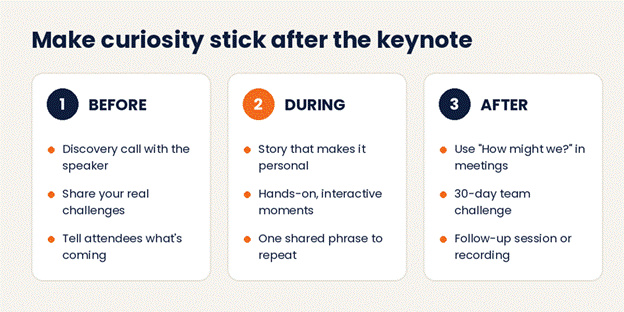
A simple before, during, and after plan.
Before the event
Book a discovery call with your speaker and share the real challenges your team is facing, not the polished version. Tell attendees what’s coming so they show up ready to participate. If you want every attendee to get full value, use an accessible event checklist.
During the event
Give the speaker room for interaction, and make sure senior leaders are in the room and participating. When leaders ask questions out loud, everyone else feels safe to do the same.
After the event
Pick one phrase from the keynote, like “How might we?”, and use it in meetings for 30 days. Run a short team challenge, share the recording or key takeaways, and consider a follow-up workshop to go deeper with managers.
Why Event Planners Book Chris Ruden as a Curiosity Keynote Speaker
Chris Ruden doesn’t teach curiosity from a textbook. He lived it. Born with a limb difference and later living with type 1 diabetes, Chris spent years hiding his hand, even sleeping in a glove. Everything changed at Disney’s Coronado Springs, when an 11-year-old girl grabbed his gloved hand and said, “It’s okay. You don’t have to hide around me.”
That moment pushed him to get curious about a different way forward. He shared a video showing his hand that reached millions of views, led to a call from Dwayne “The Rock” Johnson, and earned him a spot on season one of NBC’s Titan Games. Along the way he set world records in powerlifting and wrote *The Art of Changing Course* (Wiley).
Today Chris helps organizations build cultures people brag about, using curiosity to adapt faster and connect deeper. His “How might we?” approach helps teams let go of legacy narratives and lead change from the inside. He’s spoken for organizations including Victoria’s Secret, Citibank, Barclays, Starbucks, Dairy Farmers of America, and Leidos.
Event planners book Chris because:
- He’s high engagement without the hype. Chris is an introvert, so his sessions are interactive and experiential (think a 12-foot beach ball), not “rah-rah.”
- Every talk is customized. He starts with a conversation about your people, your challenges, and your goals.
- The message works across rooms. Leadership teams, sales kickoffs, ERGs, and company-wide events.
- He connects curiosity to culture. Signature programs include Change Is Strength, Gaining the Upper Hand, and Better I.D.E.A.S. for Better Workplace Culture. See all keynote topics.
| Planning your 2027 event? Hop on a quick call with Chris and tell him what you’ve got going on. No pressure, just a conversation to see if it’s a fit. Check Chris’s availability. |
Frequently Asked Questions About Curiosity Keynote Speakers
What does a curiosity keynote speaker talk about?
A curiosity keynote speaker covers how to ask better questions, challenge outdated assumptions, embrace change, and build trust across teams. The best talks combine a personal story with a simple framework, like “How might we?”, that people can use right away.
How is a curiosity keynote different from an innovation keynote?
An innovation keynote usually focuses on processes and ideas. A curiosity keynote focuses on the mindset and behaviors that make innovation possible in the first place: asking questions, listening, and feeling safe enough to try something new.
Is a curiosity keynote a good fit for an AI-focused event?
Yes. As AI tools become standard, the human skills around them matter more. A curiosity keynote helps people approach AI with questions instead of fear and keeps the focus on people and connection. For more on this, see our adaptability keynote speaker guide.
How long is a typical curiosity keynote?
Most keynotes run 45 to 60 minutes. Many speakers also offer shorter sessions for packed agendas, or longer workshops and breakouts that go deeper with smaller groups.
Can a curiosity keynote be delivered virtually?
Yes. A good virtual keynote uses chat, polls, and short activities to keep people engaged. It’s a strong option for distributed teams or global events.
How do we measure the impact of a curiosity keynote?
Run a short pulse survey before and after the event, track how often teams use the shared language (like “How might we?”), and watch engagement scores, ideas submitted, and cross-team projects over the next quarter.
Want help picking the right voice for your culture? Read our culture keynote speaker guide.
Sources
- Gallup, State of the Global Workplace: 2026 Report
- World Economic Forum, The Future of Jobs Report 2025, Skills Outlook
- Francesca Gino, The Business Case for Curiosity, Harvard Business Review (2018)
- ATD, The Curiosity Gap (SurveyMonkey study, 2018)
- Government Executive, If You Want to Foster Innovation, Support Curious Employees (INSEAD field study)