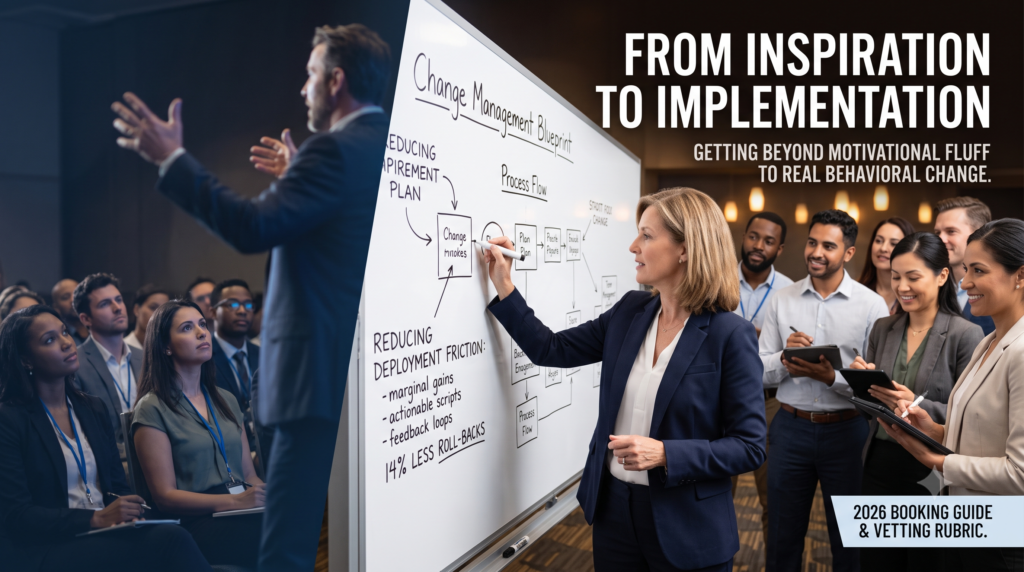
Conflict of Interest Disclosure: Companies seeking change management speakers often struggle to distinguish polished presenters from practitioners who can lead real organizational transformation. This guide is designed as an expert directory and vetting resource for leaders seeking proven keynote speakers capable of driving lasting business transformation, not temporary inspiration. I operate a booking bureau and earn commissions on placements. However, I aggressively vet for actual culture changers, filtering out the well-rehearsed speech givers who peddle motivational fluff.
The “Speech Giver” vs. The “Culture Changer”
Two years ago, I booked a “visionary” to fix my engineering team’s severe resistance to an impending software migration. He bounded onto the stage and delivered a flawless sixty minutes on embracing the future, complete with slides of mountain climbers and space shuttles. On Monday morning? Zero code shipped differently. My team went right back to their old, comfortable habits. He was a classic Speech Giver.
Six months later, I tested a different approach. I started sourcing change management speakers who treat the stage like a whiteboard. I brought in a former software director who had actually led a global tech migration. She didn’t pace; she diagrammed failure states. Instead of generic motivation, she handed my team a practical system to pull actionable insights from their weekly review meetings. By shifting their focus to making tiny, daily process improvements—what the industry calls marginal gains—our actual deployment friction dropped. Specifically, we saw 14% fewer rolled-back software updates within just three weeks of her session. That is a Culture Changer.
Equipping the Middle Manager
When a company reorganizes or shifts direction, middle managers absorb the heaviest blows. They are tasked with executing the new vision while managing the anxiety of their direct reports. The standard industry strategy throws generic keynote speakers at these exhausted groups to preach about “finding the silver lining.” But announcing that change is hard from a podium does nothing to repair a fractured organizational culture. In fact, it often backfires by invalidating the very real stress of doing more with fewer resources.
The goal is not simply to survive change management, but to help teams navigate uncertainty, build resilience, and create an organizational culture that adapts faster than competitors.
I don’t look for experts who preach generic resilience. I hire speakers who give my leaders exact scripts to stop their teams from panicking. Rather than relying on motivational talk about a growth mindset, they provide practical systems that strengthen change management and make execution repeatable. They replace empty rhetoric with actual, calendar-ready tools: exact meeting agendas, step-by-step peer feedback guides, and communication rules for de-escalating tension during quarter-end crunches. Step-by-step peer feedback guides and communication rules for de-escalating tension during quarter-end crunches. They give burned-out leaders a mechanical process for handling emotional fatigue, rather than just telling them to stay positive.
2026 Booking Checklist for Corporate Events
- Require a pre-event diagnostic call with middle management (not just the C-Suite).
- Demand a post-keynote 30-day implementation guide to sustain momentum.
- Verify a minimum six-month lead time, as top-tier practitioners book out far in advance.
Vetting True Transformation Leaders
C-suite buyers cannot risk company momentum on untested charisma. When I vet voices for successful organizational transformation and long-term business transformation initiatives, the threshold for proof shifts abruptly from inspiration to execution. The best practitioners consistently combine operational discipline with measurable innovation, giving organizations a lasting competitive advantage. I ruthlessly separate those who survived a single corporate crisis from those who possess repeatable methods for sustained innovation.
This requires deconstructing the on-stage pitch into an undeniable track record. If a speaker cannot explain the specific mechanics of how they achieved their results, they don’t make my roster. I look for the unglamorous details: how they allocated budgets, how they handled dissenting executives, and how they measured adoption.
| The On-Stage Hero’s Pitch | The Actual Practitioner’s Reality |
|---|---|
| “I led my team through the impossible.” | “I restructured capital allocation across 4 regions.” |
| “We embraced disruption.” | “I deployed a phased rollout that mitigated Q3 churn by 12%.” |
| “I fostered a culture of extreme ownership.” | “I tied 20% of executive bonuses directly to adoption metrics.” |
Elite transformation leadership requires verifiable evidence, aligning with rigorous, peer-reviewed standards like those detailed in Harvard Business Review’s research on managing complex change. Stop paying for someone else’s highlight reel and secure the architectural blueprints for your own survival.
Beyond the Stage: Securing Transformational Talent
A solitary keynote cannot fix a fractured culture. I learned this the hard way in 2019. We booked a charismatic visionary to cure a toxic merger, but we completely ignored the post-event implementation. The team experienced a 48-hour motivational sugar rush. By Wednesday, managers were back to hoarding resources, hiding bad news, and ignoring the new operating playbook. The traditional approach to change management fails when you treat keynotes as standalone entertainment.
The Executive Vetting Rubric
To hire true catalysts for your corporate events, I stopped looking at social media followers. Instead, I started asking agencies for one simple receipt: show me the 90-day retention data. I wanted to see if leaders actually applied the concepts three months later. Now, I require concrete Kirkpatrick Level 3 behavior metrics, specifically tracked through 90-day pulse surveys on platforms like Culture Amp or Microsoft Viva Glint. By demanding transparent evaluations from the speaker roster, you ensure every tailored recommendation is backed by historical ROI rather than inflated speaking fees.
Integrating the Keynote into Your Strategy
To survive digital disruption, I realized we had to anchor the message in a proven methodology like the Prosci ADKAR framework, which breaks change into five human steps: Awareness, Desire, Knowledge, Ability, and Reinforcement. A structured change management process helps organizations respond to digital disruption while creating sustainable business transformation instead of short-term enthusiasm. You cannot outsource this entire framework to a guest on a stage.
| Phase (ADKAR) | Who Owns It | The Objective |
|---|---|---|
| Awareness & Desire | The Keynote Speaker | Spark urgency and motivate the team to embrace the new vision. |
| Knowledge & Ability | Internal Leadership | Provide the training, tools, and coaching to execute the change. |
| Reinforcement | Management & HR | Measure 90-day retention, reward adoption, and prevent operational relapse. |
I stopped treating keynotes as stand-alone magic tricks. Instead, I used them as the starting gun for real business transformation. By applying this systematic approach, an inspiring hour seamlessly transitions into the daily operations of your team.
Secure Booking Channels and Logistics
Director’s Note: Why I Chose This List. I curated these professionals because they clear strict corporate hurdles and deliver lasting impact. Skip the generic contact form on a personal website. Instead, partner directly with a specialized speakers bureau, experienced booking agents, or a trusted agency with a proven speaker roster of experienced change management speakers.
The best change management speakers do far more than inspire an audience for an hour. They equip leaders with practical systems that strengthen transformation leadership, accelerate business transformation, and help organizations navigate uncertainty with confidence. When selected through a rigorous vetting process, these keynote speakers become long-term partners in measurable organizational success.