I was standing in the back of a dimly lit Marriott ballroom, watching 500 of my employees give a standing ovation to a man who had survived a harrowing Everest expedition. I had just wired his agency $40,000.
On paper, the event was a massive success. People laughed, gasped, and lined up for signed books. But three weeks later? Our employee net promoter score (eNPS) dropped two points. Two of my best senior directors quit, citing extreme burnout. The keynote survey was glowing, but our actual organizational resilience was in freefall.
I realized a sickening truth: I hadn’t bought resilience. I had bought rented applause.
It’s a trap most event organizers and corporate leaders fall into. We throw budget at temporary, “rah-rah” motivation while our teams are quietly drowning. Gartner recently reported that employee willingness to support enterprise change has collapsed to just 43%. A cool story about frostbite doesn’t fix systemic change fatigue. A sixty-minute adrenaline shot doesn’t cure economic anxiety.
I spent the next two years ruthlessly overhauling how we procure stage talent. I stopped looking for survivors and started looking for architects. If you are tired of spending five figures on temporary fluff, this is your blueprint. Here is the exact vetting roadmap I use to navigate speaker archetypes, demand trademarked frameworks, and guarantee measurable ROI long after the applause fades.
How to Choose the Right Resilience Keynote Speaker
Stop confusing a thrilling survival story with business relevance; demand behavioral expertise.
Navigating Speaker Archetypes and Credentials
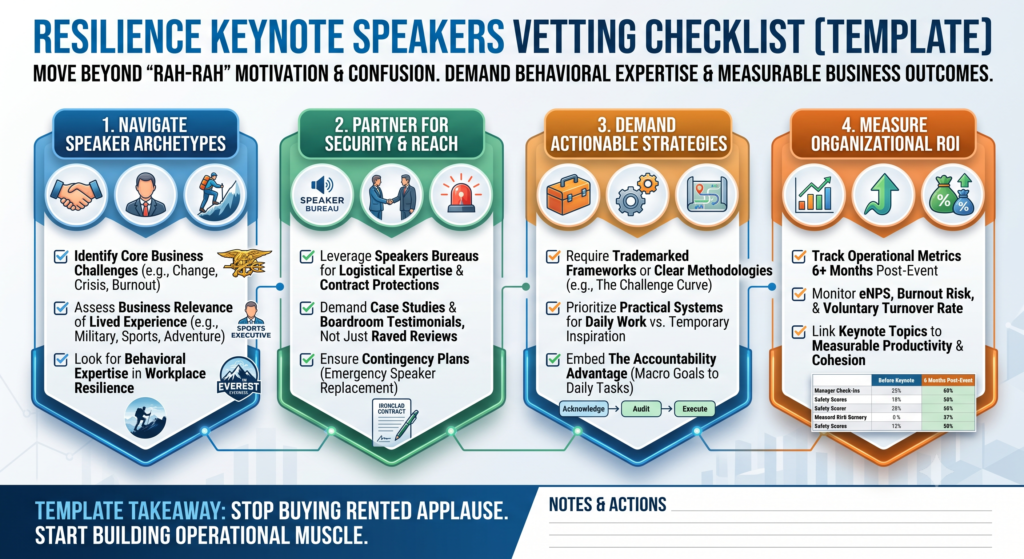
When evaluating resilience keynote speakers, I remind myself of one hard truth: a gripping real-life story is only valuable if it translates into practical business outcomes. During my speaker selection process, I don’t just look for someone who inspires. I look for a human behavior expert who understands workplace resilience and organizational change, and can equip leaders with frameworks that improve performance long after the applause ends.
Consider the fundamental differences in how lived experiences translate to practical business steps:
| Speaker Archetype | Key Example | Core Business Application |
|---|---|---|
| Military Operator | Former United States Navy SEAL | Decentralized command, rapid crisis execution, and high-stakes alignment. |
| Sports & Business Executive | Molly Fletcher | Energy management, sustained performance, and high-level negotiation. |
| Adventure Mountaineer | Jim Davidson | Systemic survival, post-traumatic growth, and slow-burn endurance under pressure. |
Different organizations benefit from different styles of resilience keynote speakers. Some organizations also benefit from insights rooted in sports psychologist principles, particularly when building mental resilience, confidence, and consistent high performance under pressure. Some organizations also benefit from insights rooted in sports psychologist principles, particularly when building mental resilience, confidence, and consistent high performance under pressure. Some connect deeply with the inspirational journey of Inky Johnson, others prefer the leadership lessons of Molly Fletcher, while teams navigating prolonged uncertainty often relate to Jim Davidson’s Mt Everest and Mt Everest experiences. The key is choosing the speaker whose expertise aligns with your organization’s current challenges rather than simply booking the biggest name.
I saw this firsthand last year. When our sales team froze during major market disruption, I didn’t need another motivational speaker. I needed a corporate resilience speaker who understood adaptive leadership. I booked a former United States Navy SEAL who taught decentralized command, helping our managers make faster decisions during uncertainty instead of waiting for approval. That practical framework immediately improved our team’s confidence in navigating organizational complexity.
I have one strict rule before letting someone on my main stage: if they can’t show me named testimonials proving their framework works in a boardroom, I pass. If they only offer a temporary emotional high without solving structural challenges, they simply don’t belong at my event.
Whether you’re planning a leadership summit, sales kickoff, HR conference, or annual corporate event, the right resilience keynote speaker should tailor their message to your audience’s specific challenges. The best speakers don’t deliver the same presentation everywhere. They customize examples, frameworks, and case studies to create relevant learning experiences that drive real impact long after the event concludes.
Partnering With Agencies Versus Direct Inquiries
I used to reach out to speakers directly to save a few dollars. Then a sudden cancellation nearly derailed my entire conference. That’s when I learned why partnering with an agency matters.
Today, industry data confirms that speaker fees are usually identical whether you book directly or through a partner. The perceived savings are a myth, and the hidden logistical risks for large corporate events are incredibly steep. The best resilience keynote speakers operate through a dedicated speakers bureau because experienced advisors simplify speaker selection and help organizations match with advisors who understand their goals.
Instead of sweating complex contract contingencies or chasing down communication lags on my own, I let my bureau partner install ironclad protections. They enforce exact timelines, manage rigorous availability holds, and handle the heavy lifting of logistics.
Think of this bureau partnership as an insurance policy for your agenda, rather than just a one-hour stage presentation. If an unforeseen emergency grounds your primary talent, an agency provides a guaranteed, fully vetted replacement. I’ve learned to prioritize the uncompromising safety of a fortified contract over a DIY booking, because an unexpected empty stage destroys attendee trust permanently.
Actionable Strategies to Navigate Uncertainty and Change
We’ve all seen it. Monday’s keynote energizes the room. By Tuesday afternoon, inboxes pile up, priorities shift, and the excitement fades. That’s why actionable strategies matter far more than motivation alone. Whether your organization is facing technological change, economic volatility, or workforce burnout, resilient employees need practical systems they can immediately apply in their daily work.
When I introduced The Challenge Curve—a straightforward three-step process where we acknowledge the threat, audit our resources, and execute the safest next step—everything shifted. My team stopped freezing under pressure.
| Traditional Survival Mode | The Challenge Curve Methodology |
|---|---|
| Forced, unstructured positivity | Step 1: Acknowledge the threat objectively |
| Hoping for market stability | Step 2: Audit available resources instantly |
| Unclear, shared responsibility | Step 3: Execute the safest next step |
Inspiration is insufficient. Methodology is mandatory. I also implemented what I call The Accountability Advantage: a system of tying every macro company goal to a single person’s Tuesday afternoon task. By embedding strict accountability into our daily workflows, I eliminated the costly guesswork of adaptation. I replaced fleeting motivation with a highly structured defense against disruption, ensuring every employee possessed the actionable strategies required to execute flawlessly. Now, when the market shifts, my workforce doesn’t panic. They simply deploy the framework. For us, overcoming adversity became a measurable, trained metric.
The framework also provides a practical roadmap for embracing change rather than resisting it. By strengthening emotional intelligence, leaders learn to eliminate distractions, focus on being present, and make better decisions under pressure while accelerating recovery after setbacks.
Combating Burnout During Economic Volatility
Executing these strategies required acknowledging a harsh reality. According to the 2025 Mercer Global Talent Trends report, over 80% of employees are at risk of burnout as organizations navigate economic volatility and increasing organizational complexity. I watched this happen firsthand. My highest performers were hitting a wall. Developing a true mindset of resilience meant helping people improve stress management, adapt to constant change, and maintain performance even when uncertainty became the norm. That’s where the right resilience keynote speaker or motivational resilience speaker creates lasting value by delivering actionable frameworks instead of temporary inspiration. Building true organizational resilience required me to shield my front lines from this pervasive fatigue actively.
Leaders need to use chaotic markets to get ahead instead of just scraping by. Learning to navigate uncertainty demands cultivating a foundational mindset of resilience across all departments. I discovered that long-term success ultimately hinges on managing your energy at a systemic level, protecting team focus when external pressures inevitably spike. I stopped waiting for the fiscal storm to pass. Instead, I equipped my team to turn industry panic into a durable competitive edge.
Post-Keynote Integration and Measuring Organizational ROI
Last year, my company hosted a $10,000 event. A client told me my keynote was the best they had ever seen. But by Wednesday, nobody remembered it. The cognitive science behind the forgetting curve is brutal for corporate events—research shows that only 10 to 20 percent of conference learning actually transfers to the workplace. Without immediate structural integration, the keynote high evaporates within 48 hours.
Translating Inspiration Into Measurable Outcomes
I stopped treating my keynotes as isolated pep talks years ago. When an organization books me to help them build high-performance cultures, I make it clear that the speech is just day one of our work together. Inspiration is useless if it cannot be tracked. Organizations that truly prioritize employee well-being don’t leave it to chance; I tell my clients to map the abstract feelings from my talk to hard numbers. If we covered workforce burnout on stage, I want to see if managers are actually checking in on their teams more frequently the following month. These behaviors tie directly to bottom-line results.
When team cohesion improves, employee attrition rates drop. This isn’t a coincidence; it is a measurable cause-and-effect relationship I have seen firsthand. Take one of my recent clients, a mid-sized logistics firm. They originally brought me in to boost team morale after a rough quarter, but I told them we needed to measure the operational impact over the following six months. If turnover didn’t drop significantly within that timeframe, they had simply purchased entertainment, not a strategic intervention. We audited their resources and tracked their exact data before and after the keynote’s follow-up program:
| Operational Metric | Before Keynote | 6 Months Post-Event |
|---|---|---|
| Manager 1-on-1 Check-ins | 1x per month | 4x per month |
| Psychological Safety Score | 4.2 / 10 | 7.8 / 10 |
| Voluntary Turnover Rate | 18% | 7% |
The most successful organizations don’t measure applause. They measure workplace productivity, employee engagement, psychological safety, and attrition rates. A successful resilience keynote should strengthen teamwork, improve communication, and build high-performance cultures that continue producing measurable business results months after the event. These metrics provide leaders with tangible evidence that their investment influenced behavior, improved collaboration, and created lasting organizational resilience rather than a short-lived motivational boost.
Conducting a Resource Audit for Long-Term Execution
Metrics prove the value, but execution demands infrastructure. Momentum dies when questions go unanswered. That is why I leave my clients with a simple system: a shared document capturing every unfiltered question asked during our breakout sessions. From there, we launch targeted pulse surveys to gauge actual shifts in their corporate culture, and deploy follow-up workshops specifically designed to strengthen teamwork.
Most importantly, I mandate accountability. Every resource document, survey, and follow-up communication must include a designated internal contact. Trust requires a name, a face, and an inbox. Inspiration without an operational mandate is just a corporate vacation. If we are going to work together, we are going to build the system, enforce the accountability, and demand a real return on your investment.
Echoes in the Marriott ballroom
I still walk to the back of the room during our corporate offsites. But I don’t look at the stage anymore. I look at the tables.
If the crowd is just sitting back and clapping, we’ve failed. If they are leaning forward, furiously writing down a framework they can apply to their workflows on Monday morning, we’ve won.
True resilience isn’t a heroic, one-off event you can inject into a culture via a 60-minute monologue. It’s an operational muscle that requires continuous tension and release. Stop writing checks for temporary inspiration. Start aggressively vetting for the experts who will help your team build the tools to climb their own mountains, long after the microphones are turned off.