It was 9:02 AM on a Wednesday, and I was staring at a completely dead #team-culture Slack channel.
We had just burned mid-five figures on a “diversity and resilience” keynote for our annual management summit. I was expecting a flurry of epiphanies and policy debates. Instead, I got three generic thumbs-up emojis and a DM from engineering asking if the leftover bagels were still in the breakroom.
The silence was brutal, but it taught me a vital lesson: generic inspiration is the enemy of systemic change.
We didn’t need another sanitized hour of storytelling to make leadership feel warm and fuzzy. We needed a sledgehammer to our management assumptions. When we finally pivoted from seeking “motivation” to hiring disability inclusion speakers with actual lived experience, the dynamic flipped overnight. These individuals weren’t just checking an awareness box; they were adaptive leadership pros who understood how to dismantle and rebuild broken workplace systems.
I spent the next two years entirely overhauling how we source, vet, and integrate these experts into our corporate structure. If you are exhausted by check-the-box awareness sessions that lead to zero actual policy changes, you need a new playbook. Here is the exact framework I use to turn corporate keynotes into a catalyst for inclusive, adaptive leadership.
Curating Adaptive Leadership Pros for Corporate Keynotes
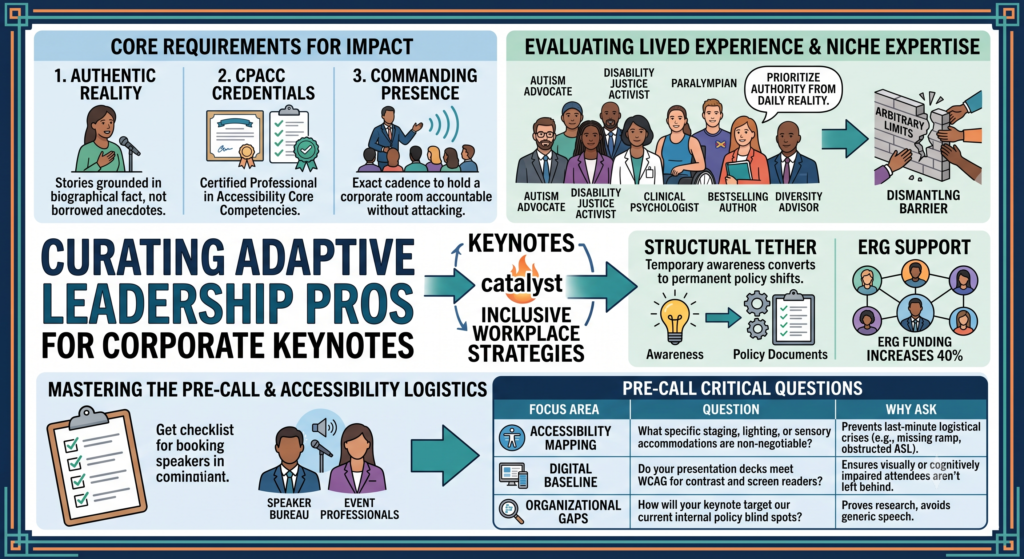
The morning after the keynote, Slack channels shouldn’t just echo with empty inspiration. I realized quickly that a one-hour presentation doesn’t change a company. I had to find speakers who actually forced managers to change their internal systems. To guarantee that impact, I rely on three absolute baselines when looking for disability inclusion speakers:
| Requirement | What It Means | Why I Demand It |
|---|---|---|
| Authentic Reality | Stories grounded in biographical fact, not borrowed anecdotes. | Genuine authority and vulnerability cannot be manufactured. |
| CPACC Credentials | Proof they’ve passed rigorous exams to become a Certified Professional in Accessibility Core Competencies. | Guarantees they possess structural, tactical knowledge of core accessibility parameters, so beginners aren’t alienated. |
| Commanding Presence | The exact cadence required to hold a corporate room accountable. | Forces executives to lean in and listen without feeling attacked. |
Evaluating Lived Experience and Niche Expertise
When I watched a leading neurodiversity expert step onto the stage last October, she didn’t cite medical journals. She described the exact physical sensation of masking through a high-stakes board meeting—the exhaustion of translating a differently wired brain into corporate syntax. By minute twenty, two executives were quietly weeping. That visceral reaction is precisely why lived experience matters.
Disability inclusion speakers come from a variety of professional backgrounds, including motivational speakers, autism advocates, disability justice activists, clinical psychologists, bestselling authors, and diversity advisors. Their combined expertise helps organizations understand disability from different perspectives while creating practical solutions for accessibility, workplace belonging, and inclusive leadership.
I always prioritize talent whose authority stems directly from their daily reality. When I hire disability inclusion speakers, I look for professionals who treat their background as a practical tool, not a tragic backstory.
For instance, when evaluating Paralympian speakers, I look far beyond the gold medals. The goal isn’t to marvel at individuals who conquered adversity; it is to study professionals who shattered arbitrary limits. This approach reframes the room’s understanding of psychological safety, proving that true advocates don’t just overcome barriers—they teach your managers how to systematically dismantle them.
Some may be a motivational speaker, autism advocate, disability justice activist, clinical psychologist, bestselling author, or diversity advisor. Each professional brings a different perspective, helping organizations understand accessibility, employee experiences, and the practical steps needed to create meaningful workplace change.
Connecting Keynotes to Inclusive Workplace Strategies
Inspiration decays rapidly without a structural tether. I demand that any event I organize converts temporary disability awareness into permanent policy shifts. An inclusive workplace doesn’t happen by accident.
True disability awareness requires more than a single event. Leaders must understand how ableism, organisational culture, disability history, and disability statistics influence workplace experiences. Many companies strengthen these efforts through employee resource groups, which provide ongoing support, education, and opportunities for employees to contribute to a more inclusive workplace.
As one Global Event Director told me recently, “The applause faded, but we immediately used the speaker’s model to secure a 40% funding increase for our neurodivergent Employee Resource Group (ERG). The event wasn’t the goal; it was the catalyst.”
I don’t just want a speaker to talk about ableism. I need them to give my managers exact, step-by-step instructions on how to handle disability employment. If a speaker shares a powerful story about experiencing the corporate world blind, the immediate corporate takeaway must be a strict audit for digital accessibility upgrades. I ensure my speakers explicitly feed their insights into broader internal initiatives, leaving executives with a strategic mandate rather than just a fleeting, warm feeling.
Mastering the Pre-Call and Accessibility Logistics
Logistics dictate impact. Last spring, I nearly derailed a high-five-figure contract for a major client event because the physical staging lacked a compliant ramp, and the venue’s sightlines blatantly obstructed the ASL interpreters. I had to scramble hours before doors opened, negotiating frantically with union carpenters to build a temporary plywood ramp just so our talent could actually get to the microphone. The sheer panic of that morning cemented a hard truth for me: you cannot host a motivational speaker advocating for equity on a fundamentally inaccessible stage.
The booking process becomes much more effective when organizations work with an experienced speakers bureau and knowledgeable event professionals. Whether companies want to book a speaker for leadership programs, disability ERG events, or virtual events, the right keynote speakers should align with organizational goals. Additional strategy sessions can help transform a single presentation into a long-term talent attraction and inclusion initiative.
When you work with a speakers bureau to lock in calendars, transparent discussions regarding pricing tiers are mandatory, but shared values are essential. Before you sign the contract and officially book a speaker, I highly recommend demanding a tough interrogation of the event details.
| Focus Area | The Question I Ask | Why I Ask This |
|---|---|---|
| Accessibility Mapping | What specific staging, lighting, or sensory accommodations are non-negotiable? | Prevents last-minute logistical crises, like the missing ramp. |
| Digital Baseline | Do your presentation decks meet the Web Content Accessibility Guidelines (WCAG) for contrast and screen readers? | Ensures visually or cognitively impaired attendees aren’t left behind. |
| Organizational Gaps | How will your keynote specifically target our current internal policy blind spots? | Proves they’ve researched your company instead of recycling a generic speech. |
Let their answers determine whether the professional is merely talking at your company, or actively helping you change it.
The view from the morning after
The real ROI of bringing in an adaptive leadership expert isn’t measured by the applause when they walk off the stage. It is measured by what happens the morning after.
If you look at our Slack channels today, the contrast is jarring. There are no crickets. Instead, managers are actively debating how to restructure our asynchronous meeting protocols and auditing our pre-call accessibility logistics. They aren’t talking about how “inspired” they feel; they are actively building the infrastructure to lead differently today than they did yesterday.
Stop paying for polite applause and surface-level motivation. Do the heavy lifting to find speakers who will force your management team to confront workplace friction and redesign your systems from the ground up. You can keep the leftover bagels—we’ll take the systemic change.