Your teams have been through restructures, new technology, shifting priorities, and more change in the last three years than in the decade before it. A resilience keynote speaker can help them recover, refocus, and get ready for what is next. The wrong one leaves them with a feel-good hour and nothing to use on Monday morning.
This guide covers what a resilience keynote speaker should actually deliver in 2027, the themes that matter most right now, how to vet speakers, what to expect on fees, and how to turn a single session into lasting change.
What Is a Resilience Keynote Speaker?
A resilience keynote speaker is a professional speaker who helps audiences build the mindset and habits to recover from setbacks, adapt to change, and keep performing under pressure. The strongest resilience speakers combine three things:
- Lived experience. They have faced real adversity, such as injury, illness, disability, failure, or loss, and can speak about it with honesty rather than borrowed anecdotes.
- A clear bridge to work. They connect their story to the challenges your people face: change fatigue, uncertainty, burnout, and resistance to new ways of working.
- Practical tools. They give leaders and teams simple frameworks they can apply right away, not just a moment of inspiration.
Resilience is not about “toughing it out.” In a workplace context, it is the shared ability of a team to absorb disruption, learn from it, and adapt faster than the change around them.
Why Workplace Resilience Is a Top Priority for 2027
The data tells a clear story: the pace of change keeps rising while people’s capacity to absorb it keeps falling.
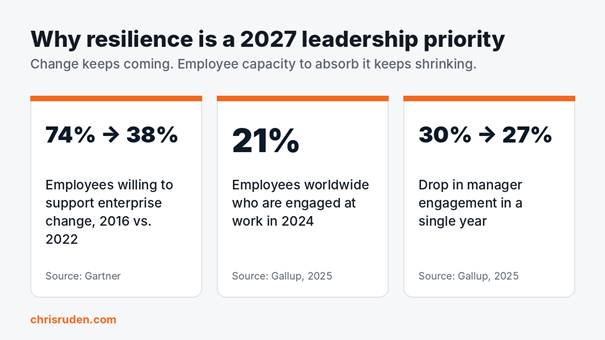
- Change fatigue is real. According to Gartner, the share of employees willing to support enterprise change fell from 74% in 2016 to 38% in 2022.
- Engagement is slipping. Gallup’s State of the Global Workplace 2025 report found only 21% of employees worldwide were engaged at work in 2024.
- Managers are carrying the load. The same Gallup report shows manager engagement fell from 30% to 27% in a single year, and managers are the people expected to lead teams through every change.
When change outpaces resilience, organizations see slower adoption of new tools, quiet resistance, and rising turnover. A well-chosen resilience keynote gives people a shared language and a reset point, which is why so many planners now book resilience and change management keynote speakers for kickoffs, all-hands meetings, and leadership summits.
What a Great Resilience Keynote Delivers
Motivation fades fast. A high-impact resilience keynote is built to change behavior, and it usually follows four stages.
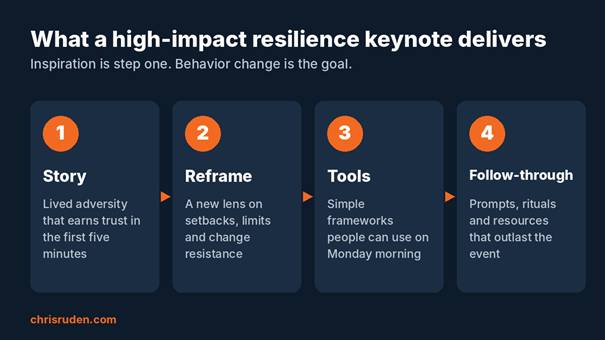
1. Story that earns trust
Audiences lean in when a speaker is honest about struggle. Authentic stories of adversity lower defenses and make it safe for people to admit their own challenges.
2. A reframe on setbacks and limits
The best speakers help audiences see limitations, resistance, and disruption differently. Instead of “why is this happening to us,” teams start asking “what can we build from this.”
3. Tools people can use immediately
Look for simple, memorable frameworks: how to focus on what is controllable, how to break a big change into small wins, and how to talk about setbacks openly with a team.
4. Follow-through that outlasts the event
Reflection prompts, team discussion guides, and follow-up resources keep the message alive long after the applause. Without this stage, even a brilliant keynote fades within weeks.
Resilience Keynote Themes That Resonate in 2027
Generic “never give up” messages no longer land. Today’s audiences respond to resilience content tied to the realities of their work:
- Resilience through constant change. Helping teams handle restructures, AI adoption, and new processes without burning out.
- Turning limitations into leadership advantages. Showing leaders how constraints can drive creativity, focus, and better decisions.
- Resilience and psychological safety. Teams recover faster when people can admit mistakes and ask for help. Our guide to how keynote speakers build psychological safety covers this in depth.
- Inclusive resilience. Recognizing that visible and invisible differences shape how people experience adversity, and designing support that works for everyone.
- Personal resilience for leaders. Managing energy, stress, and self-talk so leaders can support their teams without running on empty.
How to Choose the Right Resilience Keynote Speaker
Fame is not the same as fit. Use these criteria to narrow your shortlist.
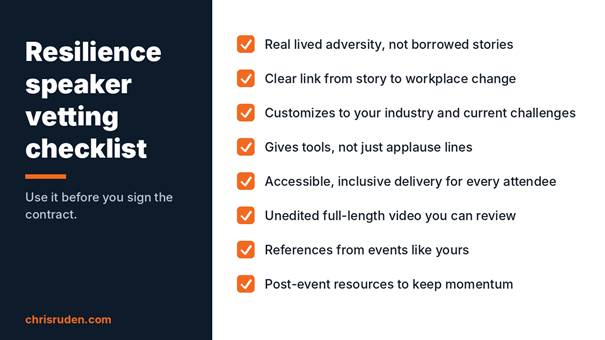
- Authentic adversity. Has the speaker personally lived through what they talk about? Audiences can tell the difference immediately.
- Relevance to your audience. Can they connect their story to your industry and your current challenges, whether that is a merger, a technology rollout, or a tough year?
- Customization. Will they do a pre-event call, learn your language, and tailor examples to your organization?
- Actionable content. Ask what attendees will be able to do differently the next day. If the answer is vague, keep looking.
- Accessible delivery. Great speakers make sure every attendee, in the room or online, can engage fully. Pair this with an accessible event plan for the best results.
- Proof. Request full-length, unedited video and references from events similar in size and audience to yours.
- Follow-up support. Ask what resources they provide after the event to reinforce the message.
Helpful questions to ask on a discovery call:
- How do you adapt your talk for a team going through change right now?
- What will our people walk away able to do?
- How do you engage hybrid or virtual audiences?
- What do you provide before and after the event?
What Does a Resilience Keynote Speaker Cost?
Fees vary widely based on demand, experience, customization, and format. As a general guide for North American events:
- $5,000 to $15,000: Emerging or niche speakers, often ideal for regional events and smaller groups.
- $15,000 to $35,000: Established professional speakers with a signature talk, a book, and strong references.
- $35,000 and up: Nationally recognized names with major media exposure and high demand.
Virtual keynotes are often priced lower than in-person sessions. Remember to budget for travel, accommodation, and AV needs, and ask about added value such as book bundles, extended Q&A, or a breakout session. For a broader look at fee tiers and well-known names, see our roundup of top leadership keynote speakers for corporate events.
How to Turn One Keynote Into Lasting Resilience
A keynote is a catalyst, not a cure. Plan the before and after with the same care as the session itself.
Before the event
- Share your goals, current challenges, and audience profile with the speaker.
- Send attendees a short teaser, such as a video clip or a question to reflect on.
During the event
- Build in a short reflection moment or pair discussion so people apply the message to their own work.
- Use live polls or anonymous Q&A to let quieter voices take part.
After the event
- Give managers a simple discussion guide to use with their teams within one week.
- Ask each leader to commit to one new habit, such as opening meetings with a quick “what is one challenge we are facing” check-in.
- Measure engagement, change adoption, and retention at three and six months to track impact.
Why Event Planners Book Chris Ruden as a Resilience Keynote Speaker
Chris Ruden was born with a limb difference and later diagnosed with an autoimmune disease, and he hid both for years before learning to turn them into strengths. Today he is a world-record-holding powerlifter, a competitor on Season 1 of NBC’s Titan Games with Dwayne “The Rock” Johnson, and the author of The Art of Changing Course: 3 Steps to Get Unstuck and Solve Your Real Problems.
As a resilience, change management, and disability inclusion keynote speaker, Chris helps organizations build the trust and adaptability teams need to thrive through continuous change. Popular programs include:
- Change Is Strength: Building future-ready teams through transformational change.
- Gaining the Upper Hand: Transforming limitations into leadership advantages.
- Better I.D.E.A.S. for Better Workplace Culture: Inclusion, Diversity, Equity, Accessibility, and Solidarity.
Chris speaks at corporate events, conferences, and all-hands meetings, both in person and virtually. As Tony Hsieh, former CEO of Zappos, put it: “Chris you brought the house down!”
Ready to give your team a resilience reset? Start the conversation with Chris to check availability for your next event.
Frequently Asked Questions About Resilience Keynote Speakers
What does a resilience keynote speaker talk about?
Resilience keynote speakers cover how individuals and teams recover from setbacks, adapt to change, and keep performing under pressure. Common topics include change management, overcoming adversity, mindset, psychological safety, and leading through uncertainty.
What is the difference between a resilience speaker and a motivational speaker?
A motivational speaker focuses mainly on energy and inspiration. A resilience keynote speaker goes further by giving audiences practical tools to handle real challenges, so the impact lasts beyond the event.
When should we book a resilience keynote?
Resilience keynotes work especially well at annual kickoffs, after a restructure or merger, during a major technology rollout, or at the end of a difficult year. Book three to six months ahead for most speakers.
How long is a resilience keynote?
Most run 45 to 60 minutes, often with Q&A. Many speakers also offer breakout sessions or workshops for deeper application.
Can a resilience keynote be delivered virtually?
Yes. Experienced speakers adapt their content for virtual and hybrid audiences using polls, chat, and interactive prompts. Virtual sessions are often priced lower than in-person events.
How do we measure the impact of a resilience keynote?
Track engagement survey scores, change adoption rates, retention, and manager feedback at three and six months. Pair the keynote with follow-up discussions so you can see behavior change, not just event ratings.
Final Thoughts: Choose Resilience That Lasts
Change is not slowing down, and your people need more than a pep talk to keep up. The right resilience keynote speaker brings an authentic story, a fresh perspective on adversity, and practical tools your teams can use right away. Define your goals, vet for fit and proof, and plan the follow-through. Do that, and one keynote can become the turning point for a stronger, more change-ready culture.